
Archives
-
Explorer les pratiques linguistiques, textuelles et artistiques francophones du point de vue de l’entredeux et de l’écart
Vol. 7 No 1 (2018)Le présent numéro de Socles (N° 11) est consacré à la publication des actes des 3° Rencontres
scientifiques du Réseau LaFEF (Langue française et Expressions Francophones) qui se sont
déroulées à Oran, les 2 et 3 Mai 2017, en partenariat entre les laboratoires LISODIP (ENS
Bouzaréah)et PREFics (Université Rennes 2) et le Ministère de l’enseignement supérieur, et
ont eu pour thème de réflexion « Explorer les pratiques linguistiques, textuelles et
artistiques francophones du point de vue de l’entre-deux et de l’écart ».
Cette thématique a pour point de départ les travaux de François Jullien, Professeur titulaire de
la chaire sur l’altérité du Collège d’études mondiales, qui fait de la question de l’entre-deux
un outil épistémologique mis en œuvre à travers un concept médiateur à explorer : celui
« d’écart ». L’entre — tel qu’il le théorise — n’est plus réduit au statut d’intermédiaire, entre
le plus et le moins, mais se déploie comme « l’à travers ». L’entre (écart mais plein de
potentialités) n’est pas non plus réductible à la catégorie de l’inter (espace plein de choses
communes, au croisement de deux ensembles), plébiscitée dans les sciences humaines et
sociales. Le concept d’entre-deux a également été exploré par le spécialiste critique de
l’interculturel J. Demorgon sous la notion d’« interité », où l’inter (dans cette nouvelle
acception) est la réalité première et fondamentale. Ainsi par exemple « l’entre-les langues »
serait plutôt le tissu ordinaire et originel du monde sociolinguistique, qui, de ce fait, est là
avant que des parties de ce continuum soit découpées et isolées sous la forme de langues, et
qui perdure après ce découpage. Il est perçu comme un « entre-les-langues » parce que des
conceptions dominantes / hégémoniques posent les langues clôturées comme priorité à la fois
cognitive, politique et historique.
L’entre-deux semble permettre une pensée de la transformation et du cheminement, de la
construction et du processus. L’entre-deux est une façon d’analyser le mouvement de création
entre deux pôles fixes ou mieux, de ces deux pôles entre autres à partir de leur entre-deux. Il
peut se décliner en direction de très nombreuses pistes. Il initie également et surtout une
nouvelle approche épistémologique et une nouvelle approche heuristique qui renverse de
façon copernicienne les rapports entre les entités identifiées et l’entre ces entités.
Cette approche s’inscrit de manière fondamentale et explicite dans le champ de
l’interdisciplinarité. Cela ouvre un regard neuf sur la façon d’aborder les phénomènes
sociaux, les créations humaines individuelles et collectives, notamment la question de
l’identité et de l’altérité, ainsi que de leurs métamorphoses contextualisées. -
Tahar DJAOUT : déterreur de lumière et passeur de mots
Vol. 5 No 1 (2016) -
Paysages minorants, dynamiques et implications
Vol. 3 No 6 (2015)Ce numéro de Socles réunit des articles sélectionnés à l’issue de la journée d’étude « Paysages minorants, dynamiques et implications » organisée le 5 mars 2014 à l’ENS de Bouzaréah faisant suite à l’appel à contribution traitant la même thématique, lancé par le laboratoire LISODIP.
Il est sans doute présomptueux de prétendre faire ici un historique, fût-il succinct, de la question de la minoration et de ses implications, stratégies, paysages, etc. tant celle-ci semble plonger ses racines très loin dans les premières recherches sociolinguistiques. Si la linguistique structuraliste n’a pas inscrit la variation dans son objet en privilégiant une entrée par les langues standard, la sociolinguistique s’est vite tournée vers les usages hétérogènes en inscrivant, dès le départ et prioritairement, l’étude des variétés linguistiques dans ses relations complexes et naturelles avec les langues nationales, dominantes, supérieures, officielles, etc. Sans doute, la notion de « minoration » a-t-elle à voir avec un paradigme de hiérarchisation langagière impliquant des niveaux (normes, classes) et des projets (politiques linguistiques, planification). Cette caractérisation a été, implicitement, utilisée dans l’élaboration du concept de « diglossie » (Ferguson, 1959), décrivant des situations où des variétés de langues sont co-présentes mais hiérarchisées en variété(s) H et variété(s) L. Toutefois, l’étude des faits de langues comme dynamiques sociolangagières et non pas (uniquement) comme résultats de processus a permis de révéler que, par exemple, le phénomène de « minoration » ne peut être décrit en référence à ses manifestations linguistiques (description sociolinguistique des variétés linguistiques et leurs contacts) mais aussi et surtout en étant adjoint aux perceptions que s’en font les locuteurs. Car
le qualificatif « minoritaire » peut autant s’appliquer à une communauté sociolinguistique majoritaire (les Chinois seraient minoritaires face aux Américains) qu’à une communauté (dite) minoritaire (les Kabyles, les Touaregs en Algérie). C’est dire que la « minoration » est plutôt une expérience qui se vit dans la différence, la rencontre, etc., ce qui implique que son appréhension devrait passer par des choix épistémologiques, théoriques, méthodologiques et éthiques ad hoc. -
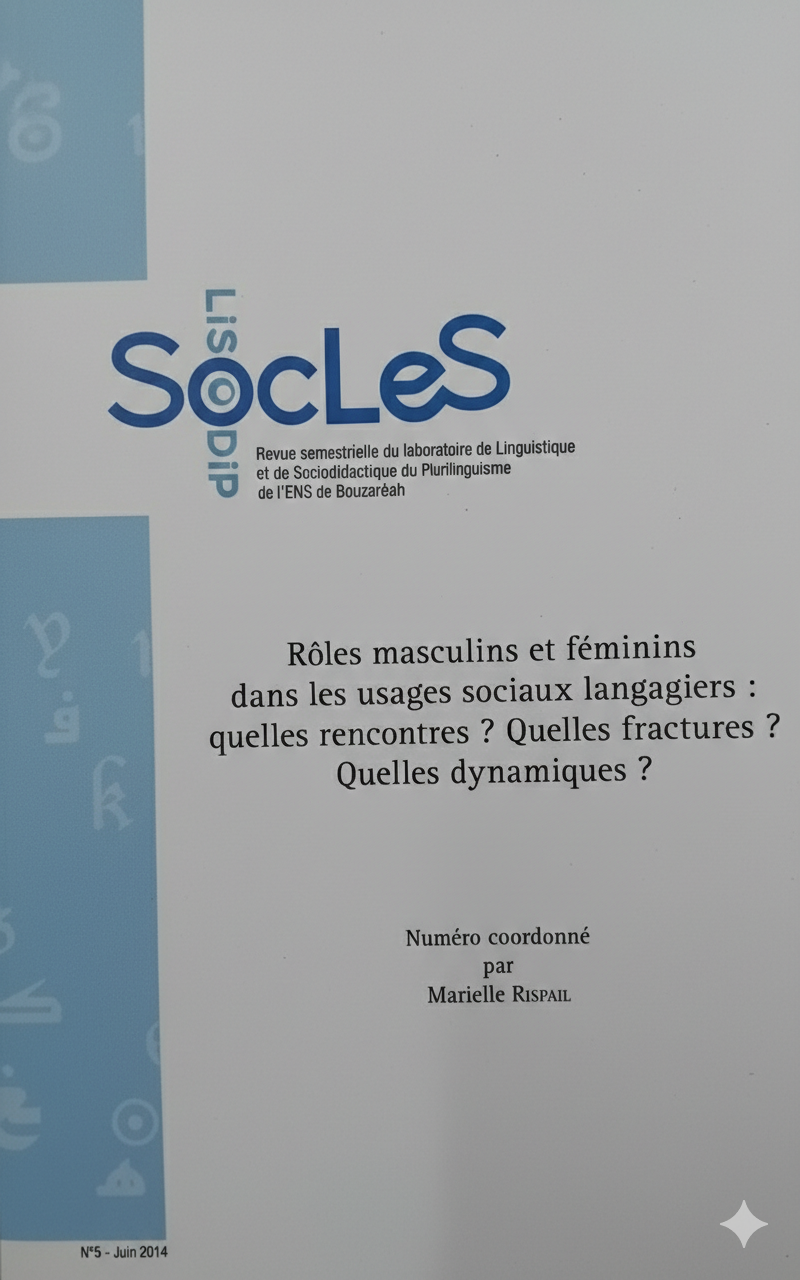
Rôles masculins et féminins dans les usages sociaux langagiers : quelles rencontres ? Quelles fractures ? Quelles dynamiques ?
Vol. 3 No 5 (2015)Le numéro que nous proposons à votre lecture est un beau florilège de la réflexion actuelle sur l’approche dite genrée, dans ses avancées et ses limites aussi. Nous remercions l’équipe du LisodiP de nous avoir fait confiance sur un sujet aussi délicat, qui paradoxalement heurte à la fois pour les pentes parfois trop rapides où il se laisse aller et les redites dans lesquelles il s’enlise déjà. Le choix de textes offerts1 témoigne de cette phase située de nos recherches collectives.
-
L’invention d’une langue littéraire dans un milieu plurilingue
Vol. 1 No 2 (2013)Ce deuxième numéro de la revue Socles fait suite aux travaux d'une journée d'étude organisée au mois de mai 2012. Les différents intervenants se sont surtout intéressé à la question de l'écriture bilingue dans la littérature francophone algérienne et ont formulé quelques pistes de recherche dans le but d'aller vers une définition de ce qu'ils ont pu appeler « la langue littéraire », et plus précisément une « langue littéraire » créée dans un contexte plurilingue.
-
Contacts de langues et Communication médiatisée par Ordinateur (CMO)
Vol. 2 No 3 (2014)L’objet du présent numéro de la revue SocLes fait suite aux travaux de la journée d’étude organisée par le LISODIP (Décembre 2013). Il s’agissait de faire un état de la recherche dans le domaine des contacts de langues dans la communication médiatisée par ordinateur (CMO).
Depuis les premiers travaux dans ce domaine (Anis, 1986 ; 1987 ; 1991), des recherches montrent que la CMO constitue un espace de socialisation pluriculturelle et de contacts de langues (Atifi, 2007 ; Feussi, 2007 ; Ledegen, 2007 ; Legros et al. 2000 ; Lomicka et Lord, 2009 ; Marcoccia et Atifi, 2006). D’autre part, à l’ère du numérique (Baccino, 2004 ; Baccino et al, 2005) et de la mondialisation, la CMO est le vecteur de base pour l’apprentissage/enseignement (Beetham et Sharpe, 2007 ; Legros et Bounouara, 2010 ; Zaidieh, 2012) et un défi pour la recherche et la didactique. -
Développement de la compétence plurilingue et pluriculturelle des apprenants De la théorie à la pratique
Vol. 2 No 4 (2014)Le présent numéro de la revue Socles s’inscrit dans le cadre du projet de recherche du laboratoire LISODIP dont l’un des objectifs consiste à repenser les rapports entre les langues en milieu scolaire algérien. En fait, la réalité plurilingue de l’école algérienne suscite un ensemble de questionnements sur le rôle des langues en présence, les unes avec les autres, précisément le rapport langue maternelle/langue étrangère. De nombreux chercheurs ont traité cette question, chacun choisissant son terrain d’investigation et adoptant une approche propre, différente de celle de l’autre. Il en résulte une abondance de définitions ne se recoupant pas toujours. Elles introduisent en conséquence un flou dans le domaine de la recherche qui se soucie des contextes sociaux dans l’approche des situations d’enseignement/apprentissage des langues-cultures. Dans cette optique, ce numéro de Socles offre l’occasion d’une part, de porter un regard critique sur les approches théoriques développées au cours de ces dernières années pour mesurer leur degré de compatibilité avec des situations d’enseignement/apprentissage des langues en Algérie et d’autre part, de réfléchir, au croisement de deux approches complémentaires : la sociolinguistique et la didactique sur la manière dont se manifeste le «déjà là » acquis ou appris en arabe algérien ou en berbère (avec toutes leurs variétés) au moment où l’apprenant construit de nouvelles connaissances en français langue étrangère.
-
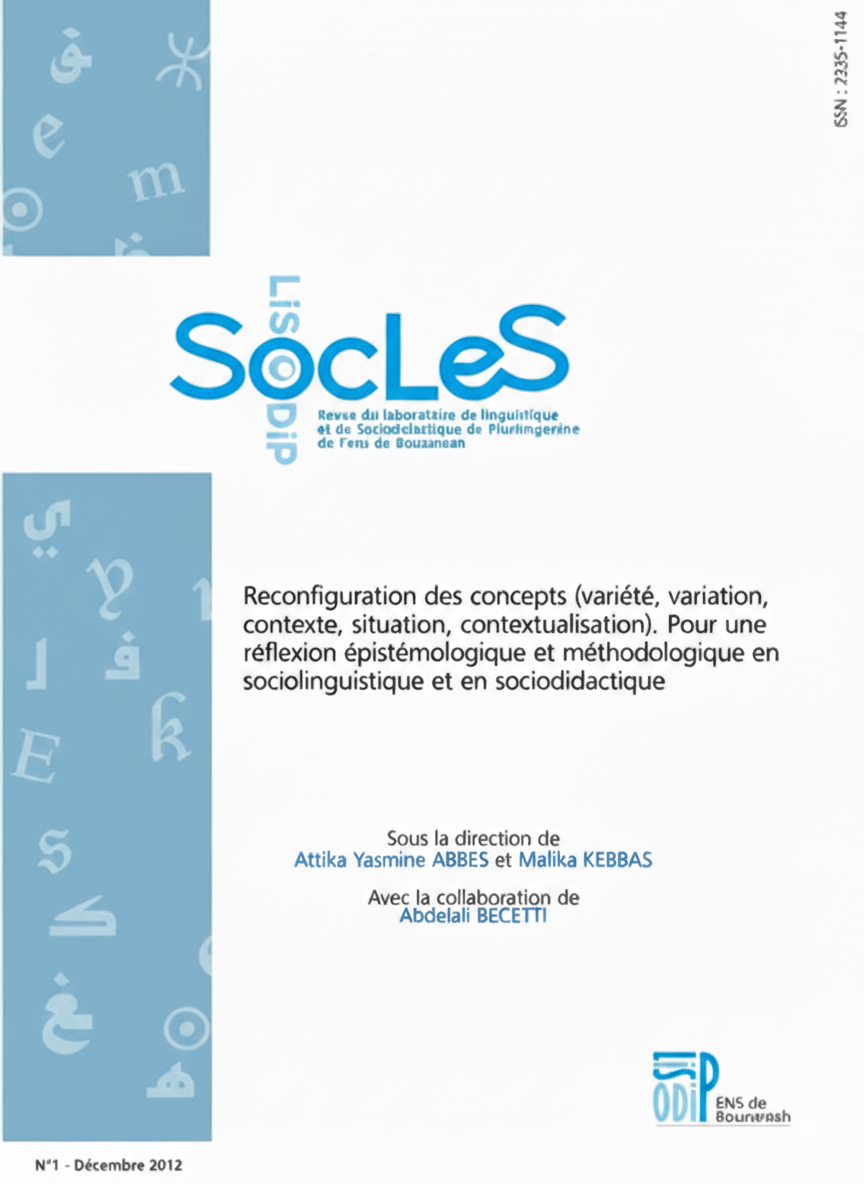
Reconfiguration des concepts Pour une réflexion épistémologique et méthodologique en sociolinguistique et en sociodidactique
Vol. 1 No 1 (2012)L'objet du présent numéro de la revue Socles fait suite aux travaux des journées d‘étude organisées par le LISODIP (Mai 2012). Notre préoccupation était de soumettre à la discussion quelques points de réflexion sur la façon dont les chercheurs, notamment dans les domaines de la sociolinguistique et de la didactique des langues et des cultures, problématisent — en vue de les re-configurer — des concepts fondamentaux tels que variété, variation, contexte, etc. Le point de départ de cette réflexion est de permettre aux chercheurs de confronter leurs points de vue, de faire part de leurs travaux et cela, dans une dialogique complexe, réflexive, herméneutique éminemment altéritaire. L‘interrogation principale qui guide le parcours de ce numéro est de s‘interroger sur la portée interprétative et heuristique des concepts tels que variété linguistique, variation, contexte, situation, contextualisation.