
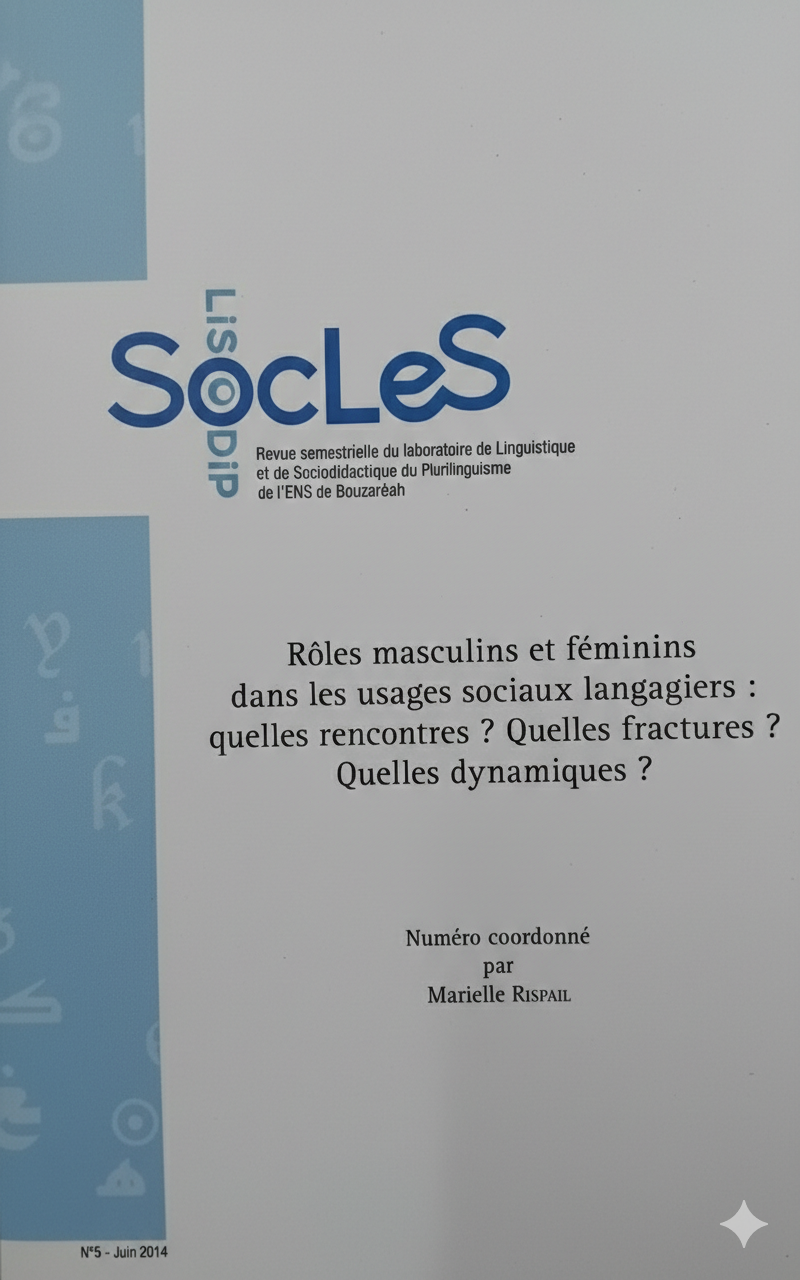
Do we study and talk about the same way at the university at the university when one is a boy or a girl? The case of Algerian students
Keywords:
linguistic variation, gender, opposition women/menAbstract
The opposition (or not?) between women and men has been the subject of several sociolinguistic studies, where it was shown that "men and women use a distinct language in all communication situations regardless of the gender of the interlocutor" (Yaguello, 2002, p. 35). Attention has therefore been paid to sexual differentiation in language uses. Missionaries, anthropologists, ethnologists and explorers were the first to be interested in this phenomenon. They arrived at several findings reinforcing the idea that the word of the man is distinguished from that of the woman. But these studies have long been limited to primitive societies insofar as it was thought that this distinction would disappear over time, particularly with modern societies (Ouvr. cité, p. 17). Nowadays, we see the emergence of the question of gender in the field of sociolinguistics, stemming from the side of the Anglo-Saxons: it renews the sexualized approach by insisting on the social variable in the differentiation of gendered roles. It is up to Labov and Sankoff to develop an appropriate methodology for the analysis of linguistic variation according to extralinguistic factors; and gendered variation is one of them, even if it was not explicitly foreseen by these authors.
Downloads
Downloads
Published
Issue
Section
License
Copyright (c) 2014 Revue Société et langues

This work is licensed under a Creative Commons Attribution-NonCommercial-NoDerivatives 4.0 International License.